
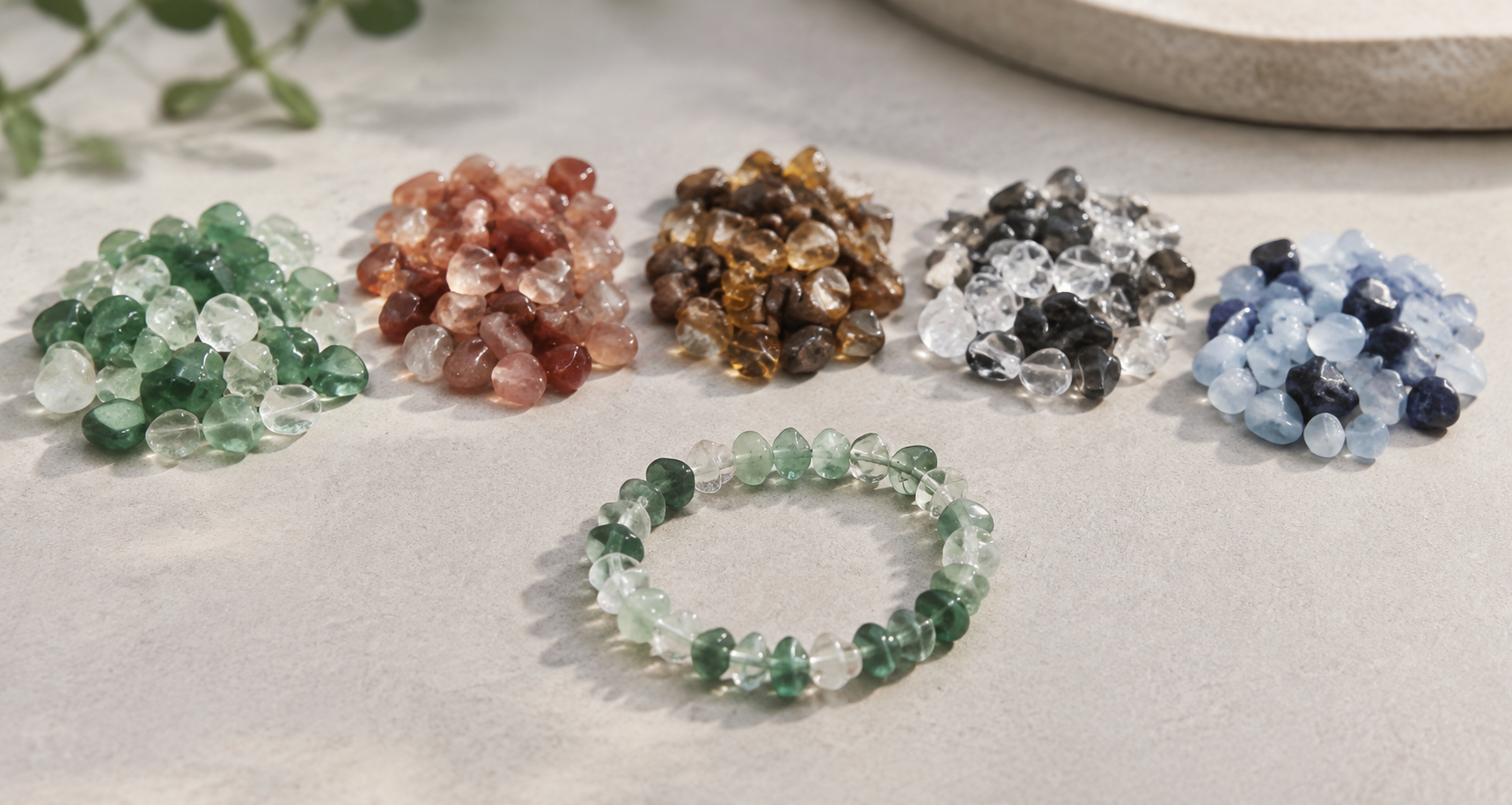
Maybe you’re starting a new job. Maybe you’re settling into a new city. Or maybe nothing dramatic happened—you just want one small thing you chose on purpose. That’s a perfectly good place to start when designing an intention bracelet.
The easiest way to choose is to name a moment in your life, pick a color story you’ll actually wear, and turn that idea into a bracelet layout. You do not need to pick the “right” crystal or believe a bead can change an outcome. Think of the bracelet as a personal cue: a wearable reminder of what matters to you now.
What is an intention bracelet?
An intention bracelet is jewelry you give a personal meaning to. The meaning might be “I’m making room for something new,” “I want to show up for my people,” or simply “I like how these colors feel together.” The intention is yours; the stones are design materials, not a test result or a promise.
Jewelry can commemorate a person or event without promising an effect. The V&A's history of jewelry includes a brooch made to mark a 1937 land-speed record. That historical example gives context for personal jewelry; it does not establish modern crystal properties.

How to choose an intention bracelet in three steps
1. Start with a real-life sentence. Finish this one: “When I look at my bracelet, I want to remember _____.” Make it specific enough to mean something to you, but not so serious that choosing beads feels like homework.
2. Choose a palette before a stone name. If you love green and cream, begin there. If warm rust and amber make you smile, that matters more than someone else’s list of “correct” crystals. A bracelet you enjoy wearing is more useful as a personal reminder than one that lives in a drawer.
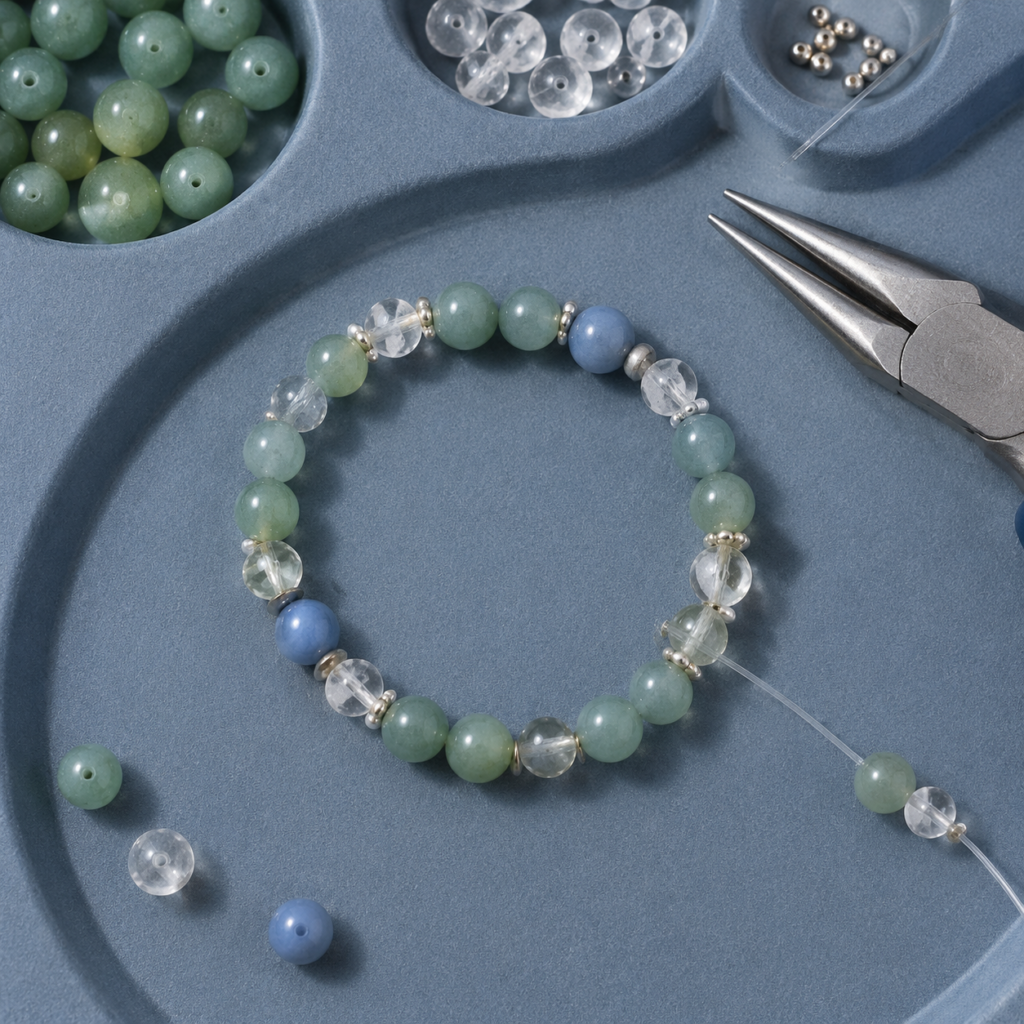
3. Build a simple rhythm. Pick one main color, one quieter companion, and one small accent. Try a symmetrical arrangement for a polished look, or shift the accent off center for something more relaxed. Check bead size and wrist fit before you finish.
Five personal starting points
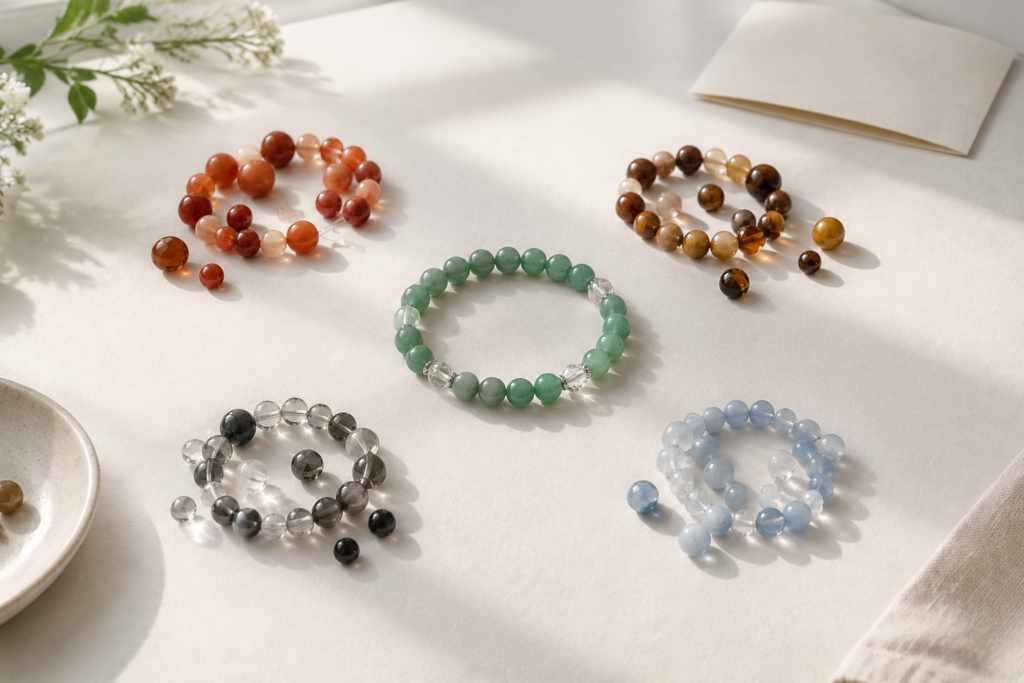
These are Wooxing’s five intention categories. Use them as prompts for color and design, not as claims that jewelry can create a result. You can choose more than one over time—and you can change your mind.
| Intention | A real-life starting point | Palette & design cue |
| Growth & Vitality | A fresh chapter or a new routine | Green aventurine-inspired greens, soft amazonite blue, and clear accents; leave visual breathing room. |
| Passion & Love | Showing warmth to yourself or people you care about | Carnelian-like orange-red, rose tones, and a small warm metal detail. |
| Wealth & Stability | Planning, saving, or building steadier habits | Tiger’s-eye-like brown-gold, smoky neutrals, and a balanced repeating pattern. |
| Focus & Wisdom | Choosing one priority in a busy season | Clear quartz-like beads, charcoal or hematite-like accents, and clean spacing. |
| Intuition & Healing | Making room for quiet reflection | Aquamarine-like pale blue, ink-blue accents, and a softer visual rhythm. |
The names are navigation labels, not outcomes. “Healing” here means a personal reflection theme, not medical care. “Wealth” is a design cue for planning and steadiness, not a promise about money. If a category feels too heavy, use the color palette and leave the label behind.
A fresh-start example: green, clear, and just enough contrast
For a new beginning, try gentle green as a main color, a few clear beads for lightness and a muted blue accent if you want more contrast. Green aventurine offers one color direction. GIA's review of optical effects describes the glittering effect called aventurescence and illustrates mica inclusions in aventurine quartz. A product photograph cannot identify the material in a particular bead.
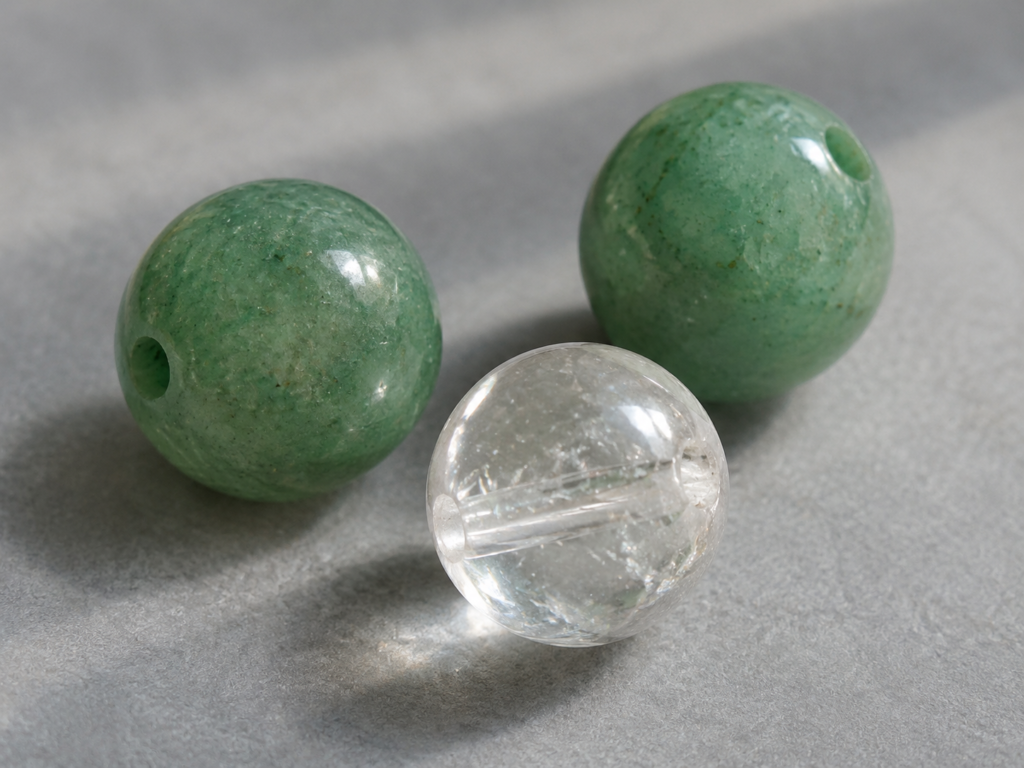
In Five Element symbolism, green can be a Wood-inspired growth cue. Balanced spacing or an off-center accent can be a separate visual choice. These are optional creative references, not a birth-chart reading or a prediction.

What if more than one intention fits?
That’s normal. Rather than trying to put five stories into one bracelet, choose the one you’d like to see on an ordinary Tuesday. You can keep the layout quiet and let one accent bead stand for a second idea. Or make a different bracelet later when your season changes. There’s no deadline and no score to get right.
A five-minute design ritual
Put three colors on a table—one main color, one neutral, and one accent. Write your one-sentence intention on a scrap of paper. Move the beads into two layouts and take a photo of each. Step away for a minute, then look at the photos beside an outfit you wear often. Choose the version you’d be happy to put on tomorrow. That’s enough.

Care and comfort matter, too
Before finalizing the design, measure your wrist in inches and check how the bead size affects the intended fit. GIA's jewelry-care guidance explains why cleaning depends on materials and treatments. Follow the complete bracelet’s instructions and ask before using an unfamiliar cleaning method.
The takeaway
To choose an intention bracelet, start with a personal sentence, a wearable palette and a simple bead rhythm. Let the jewelry represent your choice without asking it to deliver a result. Explore the current options in the WOOXING DIY bracelet designer.
Disclosure: Crystal and Five Element symbolism are personal and cultural design references. They are not medical, financial, or psychological advice, and a bracelet cannot guarantee an outcome.
Sources
Tiffany & Co. — bracelet measuring method
Victoria and Albert Museum — A History of Jewellery