
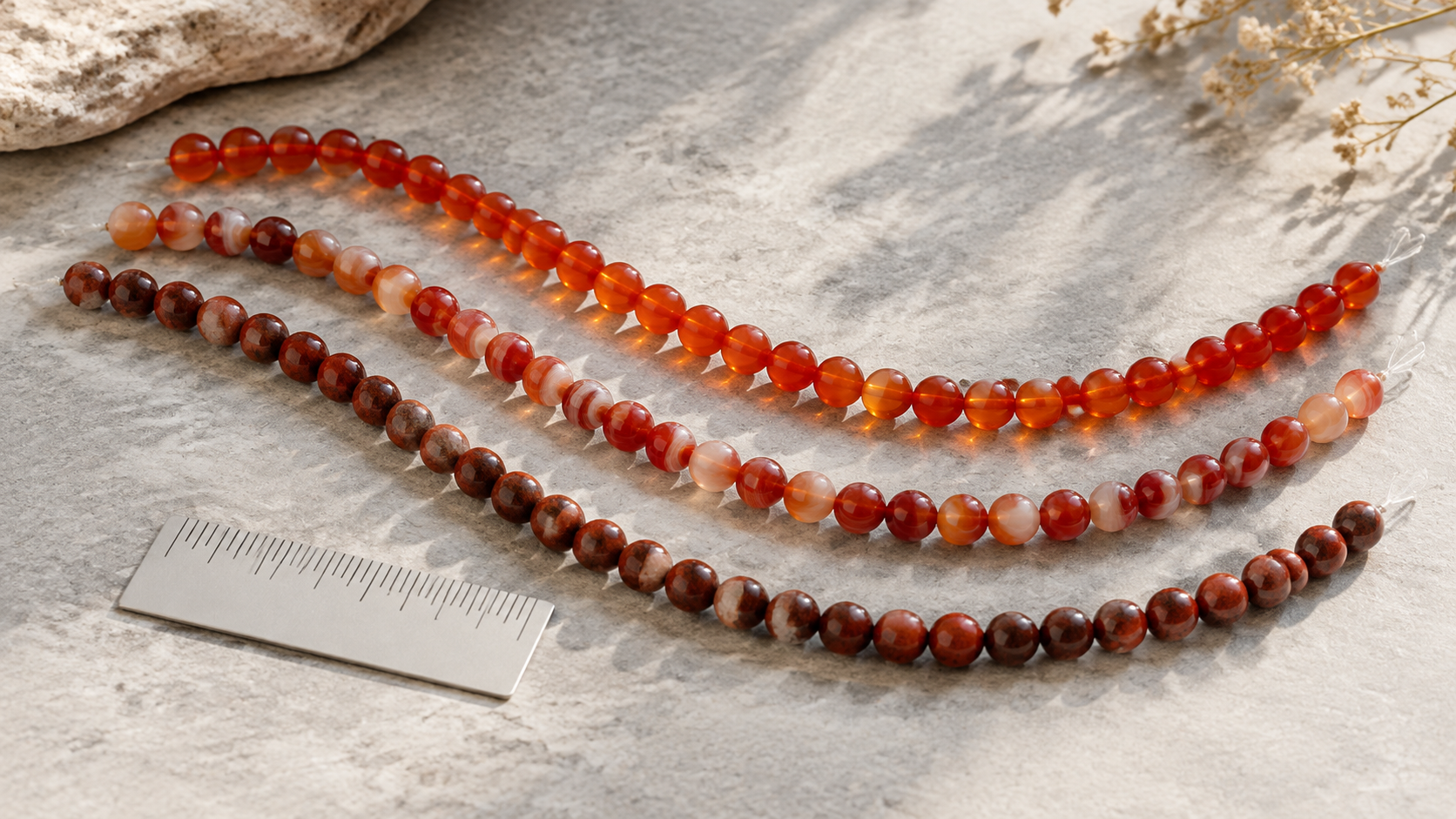
You’re shopping for warm red beads, and suddenly every listing seems to use a different name. Carnelian, red agate, banded agate—are they totally different stones, or just different ways sellers describe a similar look? The short answer: the names can overlap, and a product photo can’t settle every question.
Here’s a practical, no-drama guide to the color and pattern cues you can notice, the details a photo cannot prove, and the questions worth asking before you build a bracelet. Then you can choose the beads—and the mix—that feel most like you.
First, the names can overlap
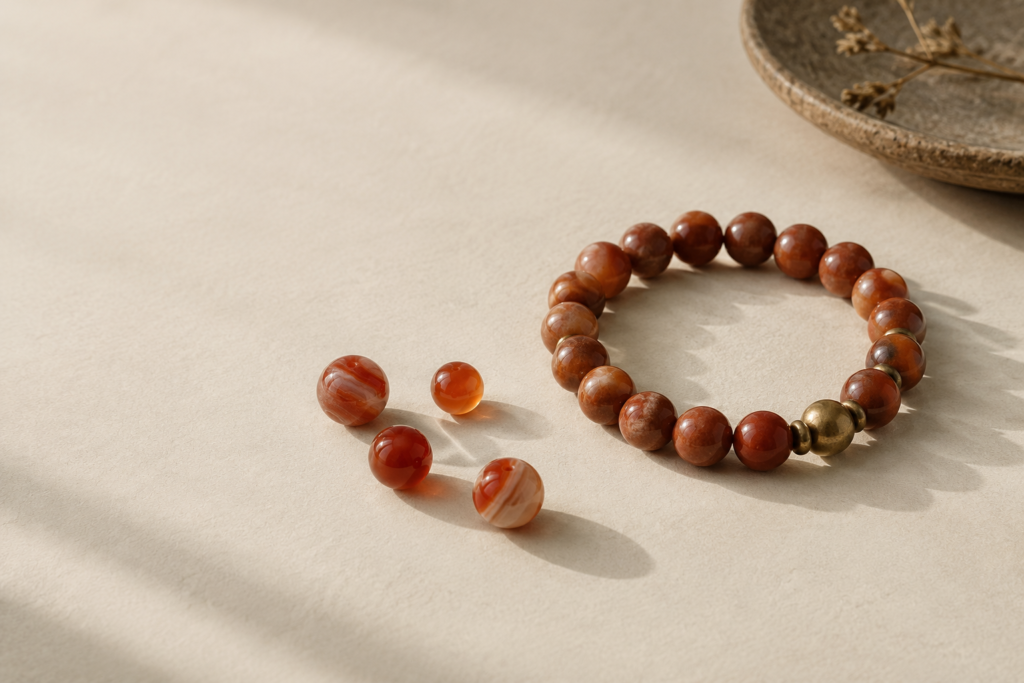
Carnelian is reddish to orange-brown chalcedony; agate is banded chalcedony. Te Ara's mineral guide distinguishes the names by color and structure. Retail descriptions can be inconsistent, so ask what the seller means by red agate rather than assuming every red bead has the same material or treatment history.
A useful visual starting point—not a lab test—is this: a fairly even, translucent rust, orange-red, or reddish-brown bead may be listed as carnelian; a bead with noticeable stripes, curved bands, or contrasting layers may be listed as agate. Nature is not obligated to follow a product-category menu, though, so some beads sit in the in-between zone.

What color and pattern can—and can’t—tell you
Color is a design clue, not a reliable ID shortcut. Lighting, background, camera white balance, screen settings, bead thickness, polish, and editing can all shift how a warm red looks online. A bead can also show natural variation from one side to another.
Banding is a more specific visual feature: agate is known for bands. Still, not every photo shows the whole bead, and a close crop may hide useful context. If the listing does not show the actual strand or multiple angles, ask for an unfiltered daylight photo or a short video of the exact beads you will receive.
And the important bit: a photo is not a lab report. It cannot conclusively verify a stone’s identity, origin, or treatment history. If those details matter to you, ask the seller what is known and how the material is described or tested.
Three helpful questions to ask a seller
- Is this the exact strand I will receive, or a representative photo?
- Are the beads described as natural, dyed, heat-treated, or otherwise treated—and what information supports that description?
- Can you share a daylight image from more than one angle, including the bead holes and any visible banding?
Not every seller will have a lab report for small beads, and that alone does not prove anything is wrong. You’re simply gathering the level of detail that fits your budget and expectations. When a claim is important, look for clear disclosure rather than guessing from a saturated product photo. GIA's introduction to gem treatments explains why treatment disclosure and care questions are separate from simply liking a bead’s color.
A little history, without the mythology overload
The Metropolitan Museum of Art records a Roman necklace with gold and carnelian beads, dated from the first century BCE to the first century CE. It is a specific example of this material in jewelry, not evidence of what every ancient wearer believed.
Today, you can give a bracelet your own meaning—maybe a color that reminds you to slow down, a bead that marks a milestone, or a combination that simply works with your closet. That personal intention is yours; it is not a scientific promise about what a crystal will do.

How to style warm red beads: subtle or statement?
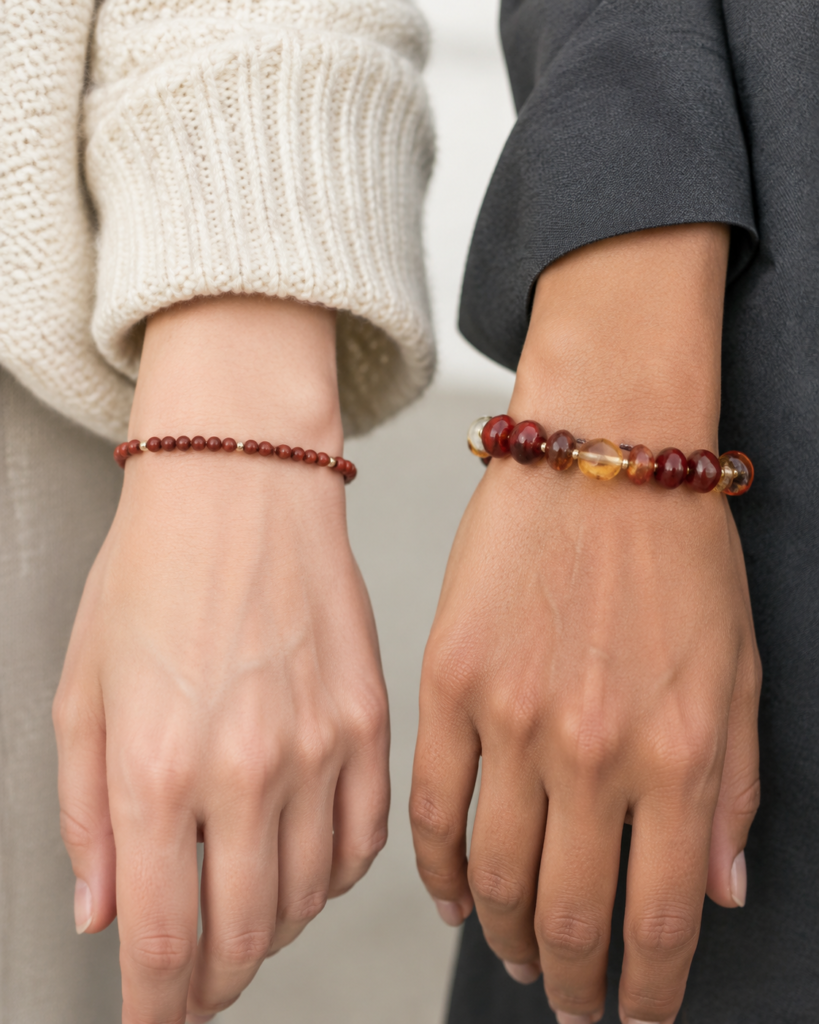
For a low-key everyday look, pair rust or brick-red beads with cream, denim, charcoal, olive, or a crisp white tee. Keep the bracelet mostly one bead tone, then add a small metal spacer or one contrasting neutral bead if you want a little polish without making it feel dressy.
Want more of a statement? Mix two or three warm shades—think burnt orange, deep cherry, and translucent amber—with a clear or smoky neutral to break up the color. Larger beads and stronger contrast read bolder; smaller beads and a tighter palette feel quieter. There is no “right” intensity—just the version you’ll actually reach for.
For a balanced custom design, pick one bead as the star, one supporting color, and one small accent. If your red beads are visibly banded, let their pattern do the talking; pair them with simpler beads so the bracelet does not feel visually busy.
A simple DIY design brief
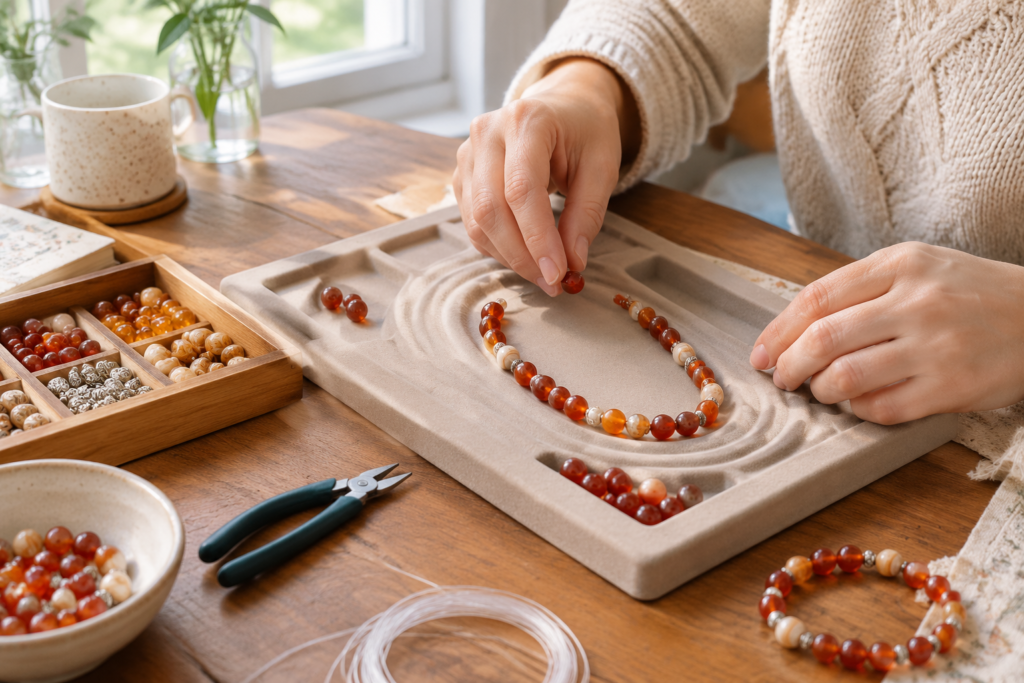
Before you string anything, decide which feel you want: everyday subtle, color-pop statement, or somewhere in between. Lay the beads out in a repeating pattern and take a quick phone photo. If the design looks balanced in a small thumbnail, it often reads clearly on the wrist too.
- Choose the focal point: mostly even-toned Carnelian-style beads, banded red agate-style beads, or a mix.
- Choose a supporting neutral: clear, smoky, cream, or deep brown beads can give warm reds a little breathing room.
- Add one accent only if it helps the rhythm: a small metal spacer or one contrasting bead is often enough.
- Check wrist fit and bead size before stringing; the finished bracelet should feel comfortable, not crowded.
Want to sketch your combination before deciding? Use the WOOXING DIY bracelet designer to explore the options currently offered. Confirm the materials, sizing and order contents before checkout.
Care that keeps it simple
For routine marks, start with a soft, dry cloth and follow the maker’s instructions for the finished piece. Store it separately. GIA's jewelry-care guidance explains why some materials and treatments need particular cleaning methods; a red color alone does not tell you which method is suitable.
A two-minute color check
Set your beads beside two outfit colors you wear often. Look at them in daylight, then take one quick phone photo. Ask yourself: does the red feel like a quiet warm accent, or do I want it to be the whole point? Pick one direction, make a small layout, and keep only the accents that help the colors feel intentional. No crystal claims required—just a design choice that feels good to wear.
The takeaway
Carnelian and red agate can overlap in color and in the way sellers use the names. Even-toned warm red beads may be listed as carnelian; visible bands often point toward agate—but photos and retail labels are not conclusive identification. Ask clear questions when material or treatment details matter, then choose the color, pattern, and bracelet layout you genuinely love.
Before ordering, save the material description, confirm the dimensions and check the care notes. The crystal bracelet buying checklist brings those practical questions together.